Binh
The SympathizerBinh is a Vietnamese character in the war film being made by Auteur, created as part of a revision that gives Vietnamese figures speaking roles but still places their lives inside an American rescue narrative. Nicknamed Benny by the Green Berets, he is written as a translator devoted to his rescuers and driven by hatred of King Cong. His scripted story ends in captivity and death; the way that ending is staged makes him both a character in the film and a measure of what its representation can—and cannot—allow him to express.
A speaking role within the film’s revised story
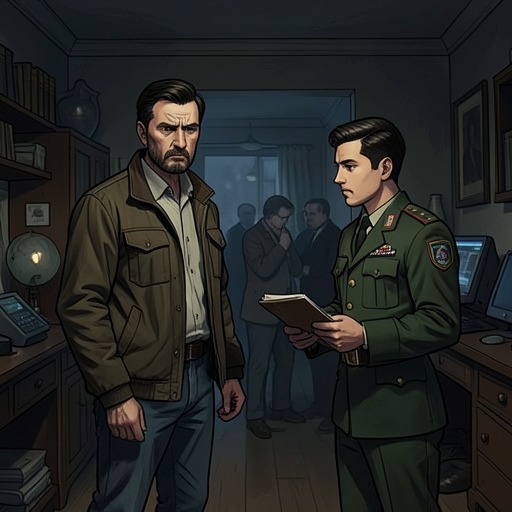
The narrator’s notes to Auteur produce a change in the script: alongside its Vietnamese screams, rendered as AIEYAAHHH!!!, the film now has three Vietnamese characters with speaking parts. Binh is the older brother. His parents have been slaughtered by King Cong, a loss that helps define his hatred of the enemy and his loyalty to the Americans who come to rescue him. The Green Berets call him Benny, and he serves them as a translator. His role gives him a function in their story, but that function is bound to their perspective: he is positioned as the Vietnamese ally who helps the American rescuers understand and defeat their foe.
Binh’s family connects his plot to the film’s other scripted Vietnamese characters. His younger sister, Mai, falls in love with the idealistic Sergeant Jay Bellamy; after King Cong kidnaps and rapes her, the Green Berets’ annihilation of King Cong’s forces is presented as the response. Their little brother, orphaned with them, is crowned with a Yankees cap in the final scene and airlifted to Jay Bellamy’s family in St. Louis, where the script promises him a golden retriever and the nickname Danny Boy. Binh’s own outcome is much darker: he and the Green Berets’ only Black soldier are marked for grisly deaths at King Cong’s hands. The three siblings therefore occupy sharply different places in the film’s moral design—Binh as doomed ally, Mai as the justification for retaliation, and the youngest boy as the rescued child given a future in America.
Capture, torture, and staged death
The film next makes Binh the sole surviving captive of a patrol encounter. Sergeant Pete Attucks’s Popular Forces squad is ambushed; Attucks steps into a bamboo bear-claw trap that seizes his left foot, and he and Binh keep firing until Attucks loses consciousness and Binh runs out of ammunition. After the Viet Cong capture them, they castrate Attucks and force his severed genitals into his mouth. The scene’s violence is presented as part of the film’s machinery for establishing the enemy’s depravity, while the narrator’s account also recalls how Claude had used images of mutilation in an interrogation course to claim a common humanity across races and wars.
Binh’s captivity becomes a water-torture sequence, staged with the same four actors who play Mai’s rapists. With Binh strapped to a plank laid over an extra playing a dead militiaman, the actors wrap a dirty cloth around his head and pour water from Attucks’s canteens. James Yoon performs the surrounding struggle, but the water itself is poured over a stunt double, whose nostrils are sealed and whose mouth holds a breathing tube. The distinction between performance and bodily danger is repeatedly exposed: the torture is simulated, yet the double’s arrangement imitates the victim’s suffocation, and Yoon later asks for water after receiving none beyond what seeped through the cloth. The narrator fetches it and trickles it down Yoon’s still-bound throat.
The shoot makes the fiction’s demand for degradation physically exhausting even without real water torture. Across repeated takes, the actors playing the captors curse, kick, and strike in simulation while trying to sustain the scene’s violence; the narrator observes that beating someone is hard work, requiring effort from both body and voice. By the final take, two hours later, Yoon’s face is covered in sweat, mucus, vomit, and tears. In the scripted ending, the captors, unable to force Binh to confess, decide to beat his brains out with a spade. They pause to smoke Attucks’s Marlboros, leaving Binh unattended; without the cloth over his head, he bites off his tongue and drowns himself in staged blood. The fake blood costs thirty-five dollars a gallon, and roughly two gallons are used to cover Yoon and the ground; Harry supplies the simulated brains, a gray mixture of oatmeal and agar. Binh never speaks an intelligible word through the torture or his death, so the film’s elaborate spectacle of punishment culminates not in a confession but in his silence.
A character made inside competing political performances
The actors playing Binh’s captors bring a history that the film’s simple division between rescuers and enemies cannot contain: they are refugees and former freedom fighters, now performing the freedom fighters on the other side. Auteur selects them for their ferocity in earlier scenes and directs them to imagine the hatred of men whose battalion has suffered heavy losses. His instructions define Binh as an imperialist puppet, a paid traitor whose captors must force him to confess his political sins. The label reverses Binh’s earlier place in the film as a Vietnamese ally and translator for the Americans: the same character is made to embody incompatible accusations of betrayal, depending on which side of the story is speaking.
The difference between the director’s instruction to act naturally and the extras’ recognition that they must act unnaturally exposes the performance as constructed. Their resentment and former political commitments do not simply disappear into the roles; they become part of the scene’s uneasy force. Binh, meanwhile, is given little space to define himself against the competing scripts imposed on him. The film can make his body signify loyalty, treachery, and victimhood, but its torture spectacle ends without an intelligible statement from him. His silence therefore marks both the limits of the character’s scripted voice and the power of the film’s makers to determine what his suffering will mean.
The limits of the camera’s witness
The scene’s final image makes Binh’s silence a problem not only for the script but also for the narrator’s own act of watching. The cinematographer moves especially close to capture Binh’s eyes, yet the narrator cannot see them from where he stands; he can only imagine a saintly expression joining ecstatic pain to painful ecstasy. That gap between the camera’s privileged close-up and the narrator’s obstructed view leaves Binh’s inner experience inaccessible even as the film presses his suffering into an image. The narrator’s comparison with The Communist Agent sharpens the divide: her degradation was real, he recalls, and he has to stop thinking of her face in order to watch James Yoon enact Binh’s fictional one. The staged scene thus exposes its own boundary between performance and remembered violence without making the two interchangeable.